Alternative Canons


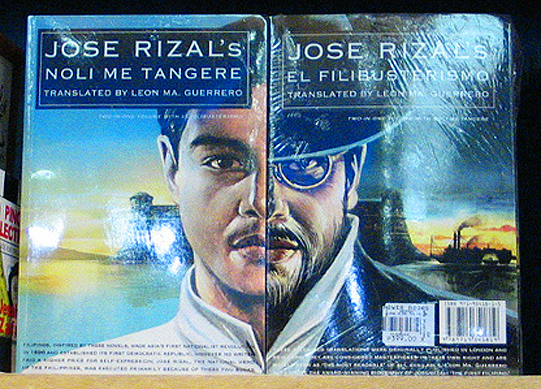
The Canon As Elite: The Case of José Rizal’s Novels
What constitute canonical literature in the Philippines are primarily the two seminal novels of the Philippines’ national hero, Dr. Jose Rizal. His Noli Me Tangere (Touch Me Not, 1887) and its sequel El Filibusterismo (Reign of Greed; The Filibustering, 1891) are considered foundational texts in the Philippines for the role and influence they have played in the colonial revolution against Spain. The novels’ protagonist is Crisostomo Ibarra, the son of a wealthy Filipino-Chinese businessman. Having studied in Europe for seven years, he returns to the Philippines only to find out that his father died in prison after incurring the wrath of the corrupt Spanish clergy who wielded the true social and political power at the time. Ibarra heroically tries to fulfill his father’s wish of building a school for all the indios, or uneducated Filipino folk. Ibarra envisions a school where the students will be taught the Spanish language, a privilege that is reserved only for those who are scions of affluent families. Through education and an ability to discourse with their masters, the Ibarras believe that the country’s progress would prove possible. However, the machinations of corrupt friars, led by the villainous Father Damaso, lead to Ibarra’s excommunication and imprisonment.
Escaping from prison and fleeing the country, Ibarra returns thirteen years later in the events of El Filibusterismo as Simoun, a wealthy yet cynical jeweler who insinuates himself into high society and influences the members of the upper class to commit abuses against the masses, with the eventual goal of instigating a revolution among the masses that will topple the status quo. In the final chapters of the book, Simoun’s quest for vengeance is distilled in a plan to commit mass murder against the members of Philippine high society.
The colonial situation during Rizal’s time reinforced the diglossic divide in Philippine language, and is an important factor in the process of literary production and transmission. Being a member of the intellectual and foreign-educated elite called ilustrado, Rizal’s background and political agenda dictated that he write primarily in the colonial language of Spanish with the end of engaging the political center in his discourse. The publication history of Rizal’s novels (Noli in Berlin, Germany; Fili in Ghent, Belgium) and their subsequent translation to the
The example of Rizal’s novels highlights how members of the intellectual elite, who have the means to produce works in the high language, often produce works that represent an aspect of the colonial context that is detached from the experience of the greater majority; essentially, as gatekeepers of ideology, they present and re-present a canonical, though not necessarily encompassing, view of the colonial context. Filipino literary critic Bienvenido Lumbera claims that this situation is true even in contemporary times, citing that writers who write in the high language
